Rise of Nazi Germany
Amidst a worldwide economic depression and political fragmentation, the Nazi Party rapidly increased its support, reaching a high of 37 percent in mid-1932 elections,[39][40] by campaigning on issues such as anticommunism and economic recovery.[41][42] Hitler was appointed chancellor in January 1933 in a backroom deal supported by right-wing politicians.[39] Within months, all other political parties were banned, the regime seized control of the media,[43] tens of thousands of political opponents—especially communists—were arrested, and a system of camps for extrajudicial imprisonment was set up.[44] The Nazi regime cracked down on crime and social outsiders—such as Roma and Sinti, homosexual men, and those perceived as workshy—through a variety of measures, including imprisonment in concentration camps.[45] The Nazis forcibly sterilized 400,000 people and subjected others to forced abortions for real or supposed hereditary illnesses.[46][47][48]
Although the Nazis sought to control every aspect of public and private life,[49] Nazi repression was directed almost entirely against groups perceived as outside the national community. Most Germans had little to fear provided they did not oppose the new regime.[50][51] The new regime built popular support through economic growth, which partly occurred through state-led measures such as rearmament.[43] The annexations of Austria (1938), Sudetenland (1938), and Bohemia and Moravia (1939) also increased the Nazis’ popular support.[52] Germans were inundated with propaganda both against Jews[43] and other groups targeted by the Nazis.[47]
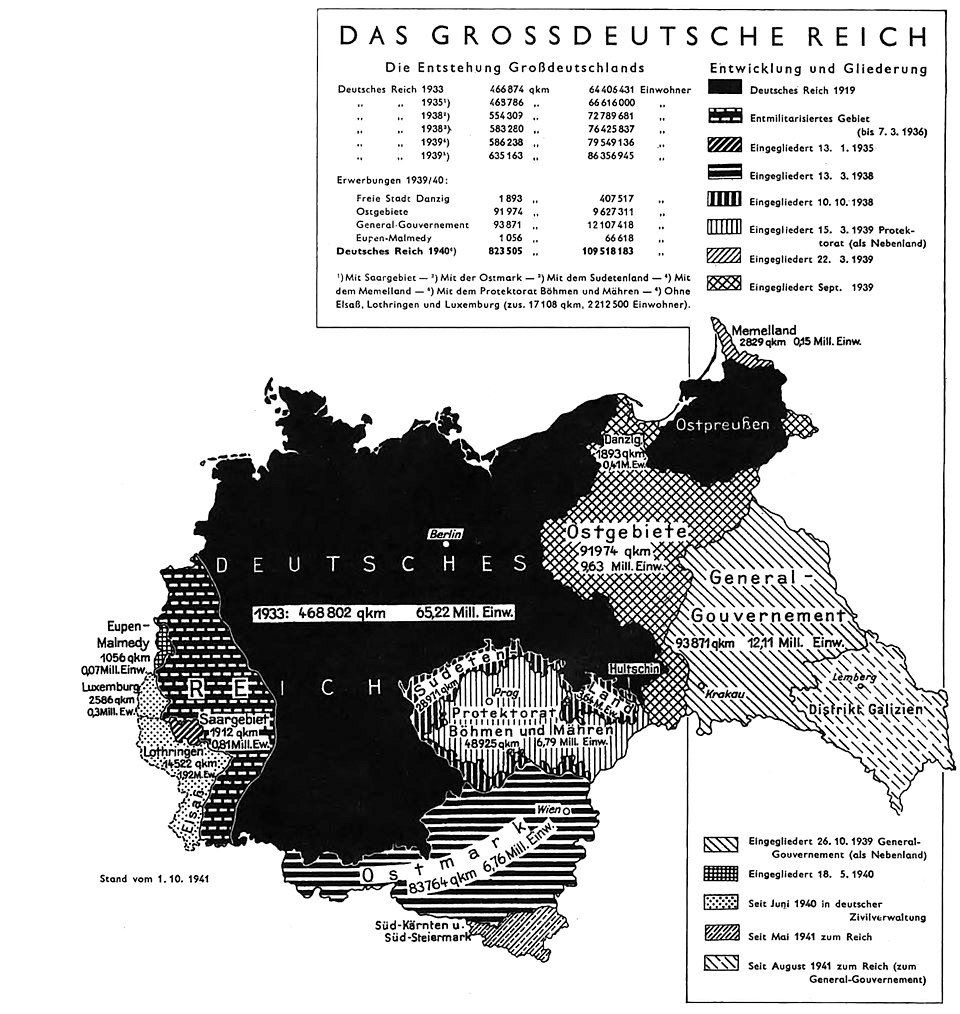
Territorial expansion of Germany from 1933 to 1941
Persecution of Jews
The roughly 500,000 German Jews made up less than 1 percent of the country’s population in 1933. They were wealthier on average than other Germans and largely assimilated, although a minority were recent immigrants from eastern Europe.[53][54][55] Various German government agencies, Nazi Party organizations, and local authorities instituted about 1,500 anti-Jewish laws.[56] In 1933, Jews were banned or restricted from several professions and the civil service.[52] After hounding the German Jews out of public life by the end of 1934, the regime passed the Nuremberg Laws in 1935.[57] The laws reserved full citizenship rights for those of “German or related blood”, restricted Jews’ economic activity, and criminalized new marriages and sexual relationships between Jews and non-Jewish Germans.[58][59] Jews were defined as those with three or four Jewish grandparents; many of those with partial Jewish descent were classified as Mischlinge, with varying rights.[60] The regime also sought to segregate Jews with a view to their ultimate disappearance from the country.[57] Jewish students were gradually forced out of the school system. Some municipalities enacted restrictions governing where Jews were allowed to live or conduct business.[61] In 1938 and 1939, Jews were barred from additional occupations, and their businesses were expropriated to force them out of the economy.[59]
A building that has been ransacked with debris strewn around
View of the old synagogue in Aachen after its destruction during Kristallnacht
Anti-Jewish violence, largely locally organized by members of Nazi Party institutions, took primarily non-lethal forms from 1933 to 1939.[62] Jewish stores, especially in rural areas, were often boycotted or vandalized.[63] As a result of local and popular pressure, many small towns became entirely free of Jews and as many as a third of Jewish businesses may have been forced to close.[64] Anti-Jewish violence was even worse in areas annexed by Nazi Germany.[65] On 9–10 November 1938, the Nazis organized Kristallnacht (Night of Broken Glass), a nationwide pogrom. Over 7,500 Jewish shops (out of 9,000) were looted, more than 1,000 synagogues were damaged or destroyed,[66] at least 90 Jews were murdered,[67] and as many as 30,000 Jewish men were arrested,[68][69] although many were released within weeks.[70] German Jews were levied a special tax that raised more than 1 billion Reichsmarks (RM).[71][c]
The Nazi government wanted to force all Jews to leave Germany.[74] Out of the 560,000 Jews in the country, 130,000 were able to emigrate between 1933 and 1937, most of them towards South Africa, Mandatory Palestine, and South America. Some went back to Eastern Europe. Another 120,000 left Germany in 1938 and 1939. Almost no country lowered the restrictions to immigrate, so obtaining the necessary documents was difficult. By the end of 1939, most Jews who could emigrate had already done so; those who remained behind were disproportionately elderly, poor, or female.[75] Until 1939 100,000 were in USA; 50,000 each in Palestine, UK, Argentina; 30,000 each in the Netherlands, Belgium, France, South Africa, and Shanghai.[1][76] Germany collected emigration taxes of nearly 1 billion RM,[c] mostly from Jews.[77] The policy of forced emigration continued into 1940.[78]
Besides Germany, a significant number of other European countries abandoned democracy for some kind of authoritarian or fascist rule.[35] Many countries, including Bulgaria, Hungary, Poland, Romania, and Slovakia, passed antisemitic legislation in the 1930s and 1940s.[79] In October 1938, Germany deported many Polish Jews in response to a Polish law that enabled the revocation of citizenship for Polish Jews living abroad.[80][81]

View of the old synagogue in Aachen after its destruction during Kristallnacht
Start of World War II
Danzigers rallying for Hitler, shortly after the free city’s annexation into Germany
The German Wehrmacht (armed forces) invaded Poland on 1 September 1939, triggering declarations of war from the United Kingdom and France.[82] During the five weeks of fighting, as many as 16,000 civilians, hostages, and prisoners of war may have been shot by the German invaders;[83] there was also a great deal of looting.[84] Special units known as Einsatzgruppen followed the army to eliminate any possible resistance.[85] Around 50,000 Polish and Polish Jewish leaders and intellectuals were arrested or executed.[86][87] The Auschwitz concentration camp was established to hold those members of the Polish intelligentsia not killed in the purges.[88] Around 400,000 Poles were expelled from the Wartheland in western Poland to the General Governorate occupation zone from 1939 to 1941, and the area was resettled by ethnic Germans from eastern Europe.[89]
The rest of Poland was occupied by the Soviet Union, which invaded Poland from the east on 17 September pursuant to the German–Soviet pact.[90] The Soviet Union deported hundreds of thousands of Polish citizens to the Soviet interior, including as many as 260,000 Jews who largely survived the war.[91][92] Although most Jews were not communists, some accepted positions in the Soviet administration, contributing to a pre-existing perception among many non-Jews that Soviet rule was a Jewish conspiracy.[93] In 1940, Germany invaded much of western Europe including the Netherlands, Belgium, Luxembourg, France, and Denmark and Norway.[82] In 1941, Germany invaded Yugoslavia and Greece.[82] Some of these new holdings were fully or partially annexed into Germany while others were placed under civilian or military rule.[83]
The war provided cover for “Aktion T4”, the murder of around 70,000 institutionalized Germans with mental or physical disabilities at specialized killing centers using poison gas.[89][94][95] The victims included all 4,000 to 5,000 institutionalized Jews.[96] Despite efforts to maintain secrecy, knowledge of the killings leaked out and Hitler ordered a halt to the centralized killing program in August 1941.[97][98][99] Decentralized killings via denial of medical care, starvation, and poisoning caused an additional 120,000 deaths by the end of the war.[98][100] Many of the same personnel and technologies were later used for the mass murder of Jews.[101][102]
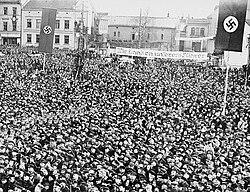
Danzigers rallying for Hitler, shortly after the free city‘s annexation into Germany
Ghettoization and resettlement
Germany gained control of 1.7 million Jews in Poland.[55][103] The Nazis tried to concentrate Jews in the Lublin District of the General Governorate. 45,000 Jews were deported by November and left to fend for themselves, causing many deaths.[104] Deportations stopped in early 1940 due to the opposition of Hans Frank, the leader of the General Governorate, who did not want his fiefdom to become a dumping ground for unwanted Jews.[105][106] After the conquest of France, the Nazis considered deporting Jews to French Madagascar, but this proved impossible.[107][108] The Nazis planned that harsh conditions in these areas would kill many Jews.[107][106] In September 1939, around 7,000 Jews were killed, alongside thousands of Poles, however, they were not systematically targeted as they would be later, and open mass killings would subside until June 1941.[109]
During the invasion, synagogues were burned and thousands of Jews fled or were expelled into the Soviet occupation zone.[110] Various anti-Jewish regulations were soon issued. In October 1939, adult Jews in the General Governorate were required to perform forced labor.[111] In November 1939 they were ordered to wear white armbands.[112] Laws decreed the seizure of most Jewish property and the takeover of Jewish-owned businesses. When Jews were forced into ghettos, they lost their homes and belongings.[111]
The first Nazi ghettos were established in the Wartheland and General Governorate in 1939 and 1940 on the initiative of local German administrators.[113][114] The largest ghettos, such as Warsaw and Łódź, were established in existing residential neighborhoods and closed by fences or walls. In many smaller ghettos, Jews were forced into poor neighborhoods but with no fence.[115] Forced labor programs provided subsistence to many ghetto inhabitants, and in some cases protected them from deportation. Workshops and factories were operated inside some ghettos, while in other cases Jews left the ghetto to work outside it.[116] Because the ghettos were not segregated by sex some family life continued.[117] A Jewish community leadership (Judenrat) exercised some authority and tried to sustain the Jewish community while following German demands. As a survival strategy, many tried to make the ghettos useful to the occupiers as a labor reserve.[118][119] Jews in western Europe were not forced into ghettos but faced discriminatory laws and confiscation of property.[120][121][122]
Rape and sexual exploitation of Jewish and non-Jewish women in eastern Europe was common.[123]
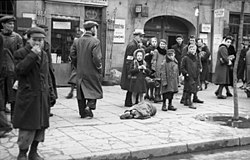
A body lying in the street of the Warsaw Ghetto in the General Governorate
Invasion of the Soviet Union
Germany and its allies Slovakia, Hungary, Romania, and Italy invaded the Soviet Union on 22 June 1941.[124][106] Although the war was launched more for strategic than ideological reasons,[125] what Hitler saw as an apocalyptic battle against the forces of Jewish Bolshevism[126] was to be carried out as a war of extermination with complete disregard for the laws and customs of war.[127][128] A quick victory was expected[129] and was planned to be followed by a massive demographic engineering project to remove 31 million people and replace them with German settlers.[130] To increase the speed of conquest the Germans planned to feed their army by looting, exporting additional food to Germany, and to terrorize the local inhabitants with preventative killings.[131][132] The Germans foresaw that the invasion would cause a food shortfall and planned the mass starvation of Soviet cities and some rural areas.[133][134][135] Although the starvation policy was less successful than planners hoped,[136] the residents of some cities, particularly in Ukraine, and besieged Leningrad, as well as the Jewish ghettos, endured human-made famine, during which millions of people died of starvation.[137][138]
By mid-June 1941, about 30,000 Jews had died, 20,000 of whom had starved to death in the ghettos.[139]
Public execution of Masha Bruskina, a Belarusian Jew who helped Soviet prisoners escape
Soviet prisoners of war in the custody of the German Army were intended to die in large numbers. Sixty percent—3.3 million people—died, primarily of starvation,[140][141] making them the second largest group of victims of Nazi mass killing after European Jews.[142][143] Jewish prisoners of war and commissars were systematically executed.[144][145] About a million civilians were killed by the Nazis during anti-partisan warfare, including more than 300,000 in Belarus.[146][147] From 1942 onwards, the Germans and their allies targeted villages suspected of supporting the partisans, burning them and killing or expelling their inhabitants.[148] During these operations, nearby small ghettos were liquidated and their inhabitants shot.[149] By 1943, anti-partisan operations aimed for the depopulation of large areas of Belarus.[150][151] Jews and those unfit for work were typically shot on the spot with others deported.[149][152] Although most of those killed were not Jews,[147][150] anti-partisan warfare often led to the deaths of Jews.[153]
Second half of the war
Continuing killings
Jews from Carpathian Ruthenia, annexed by Hungary in 1938,[367] on the selection ramp at Auschwitz II in May or June 1944. Men are lined up to the right, women and children to the left. About 25 percent were selected for work and the rest gassed.[245]
After German military defeats in 1943, it became increasingly evident that Germany would lose the war.[368][369] In early 1943, 45,000 Jews were deported from German-occupied northern Greece, primarily Salonica, to Auschwitz, where nearly all were killed.[370] After Italy switched sides in late 1943, Germany deported several thousand Jews from Italy and the former Italian occupation zones of France, Yugoslavia, Albania, and Greece, with limited success.[371][372] Attempts to continue deportations in Western Europe after 1942 often failed because of Jews going into hiding and the increasing recalcitrance of local authorities.[373] Most Danish Jews escaped to Sweden with the help of the Danish resistance in the face of a half-hearted German deportation effort in late 1943.[374] Additional killings in 1943 and 1944 eliminated all remaining ghettos and most surviving Jews in Eastern Europe.[200] Belzec, Sobibor, and Treblinka were shut down and destroyed.[375][376]
The largest murder action after 1942 was that against the Hungarian Jews.[377] After the German invasion of Hungary in 1944, the Hungarian government cooperated closely in the deportation of 437,000 Jews in eight weeks, mostly to Auschwitz.[378][367][379] The expropriation of Jewish property was useful to achieve Hungarian economic goals and sending the Jews as forced laborers avoided the need to send non-Jewish Hungarians.[380] Those who survived the selection were forced to provide construction and manufacturing labor as part of a last-ditch effort to increase the production of fighter aircraft.[285][381] Although the Nazis’ goal of eliminating any Jewish population from Germany had largely been achieved in 1943, it was reversed in 1944 as a result of the importation of these Jews for labor.[382]
Death marches and liberation
Following Allied advances, the SS deported concentration camp prisoners to camps in Germany and Austria, starting in mid-1944 from the Baltics.[383] Weak and sick prisoners were often killed in the camp and others were forced to travel by rail or on foot, usually with no or inadequate food.[384][385] Those who could not keep up were shot.[386] The evacuations were ordered partly to retain the prisoners as forced labor and partly to avoid allowing any prisoners to fall into enemy hands.[387][385] In October and November 1944, 90,000 Jews were deported from Budapest to the Austrian border.[388][389] The transfer of prisoners from Auschwitz began in mid-1944, the gas chambers were shut down and destroyed after October, and in January most of the remaining 67,000 Auschwitz prisoners were sent on a death march westwards.[386][390]
In January 1945, more than 700,000 people were imprisoned in the concentration camp system, of whom as many as a third died before the end of the war.[337] At this time, most concentration camp prisoners were Soviet and Polish civilians, either arrested for real or supposed resistance or for attempting to escape forced labor.[337] The death marches led to the breakdown of supplies for the camps that continued to exist, causing additional deaths.[384] Although there was no systematic killing of Jews during the death marches,[391] around 70,000 to 100,000 Jews died in the last months of the war.[392] Many of the death march survivors ended up in other concentration camps that were liberated in 1945 during the Western Allied invasion of Germany. The liberators found piles of corpses that they had to bulldoze into mass graves.[393][394][395] Some survivors were freed there[395] and others had been liberated by the Red Army during its march westwards.[396]